Customer Login

Think about your last hotel stay. Did you pick up the room phone? If you did, it was probably to ask reception for extra towels. And that was it.
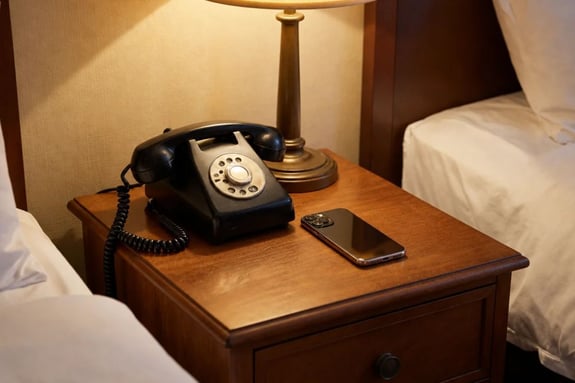
You are not alone. The average hotel guest checks in carrying three mobile devices with them, according to USA Today. When guests want something, most of them would rather type than talk. In a 2025 eviivo survey of 430 travelers, 58% said they prefer SMS, WhatsApp or email links to reach a hotel.
The room phone also stopped making money a long time ago. PKF research shows telecom revenue at the average US hotel fell 79% between 2000 and 2011, from $1,274 to $269 per available room. By 2011, hotels spent $1.46 for every dollar of telecom revenue they earned.
The current numbers are even more dire. So why keep a phone in the room at all? Two reasons: safety and habit.
Safety. In the US, Kari's Law requires multi-line phone systems, like the ones in hotels, to dial 911 directly without a prefix and to alert staff on site. RAY BAUM's Act adds that every 911 call must share a dispatchable location, like the room number. A guest's own mobile can't tell a dispatcher which room they are in. A wired room phone can.
Habit. When something goes wrong at 2 a.m., guests still reach for the nightstand. Everyone knows how a phone works.
So the real question is not if you need a phone. It is which one. Here are five options, explained simply.
1. Analog phones on an on-site PBX
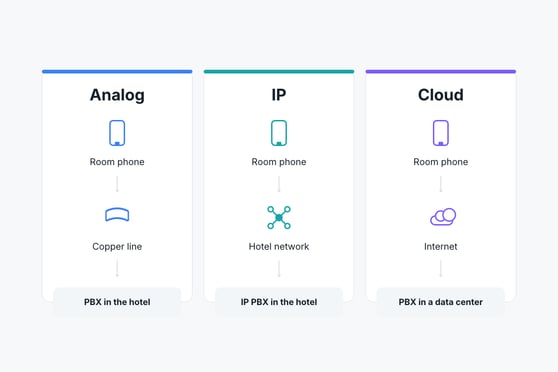
This is the classic setup. Copper cables run to every room, and a phone switch (the PBX) sits in a back office.
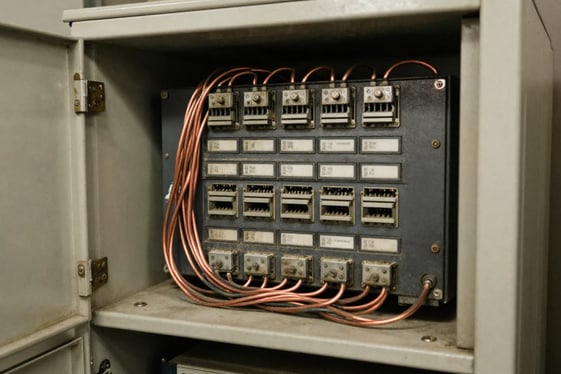
Good for: hotels with a system that still works and wiring that is already paid for. Analog handsets are cheap and durable.
Watch out for: the network underneath is disappearing. In the UK, Openreach switches off the old copper phone network on 31 January 2027, and it has said there will be no extension. Germany has no fixed date yet, but the Bundesnetzagentur is preparing the move away from copper, with switch-offs realistic from 2030. Spare parts and technicians for old PBX systems are also getting harder to find.
The good news: you don't always have to rip everything out. Many hotels keep their analog handsets and connect the PBX to an internet line (a SIP trunk) instead.
2. IP phones on an on-site IP PBX
Here the phones plug into the hotel network, and calls run as data. The PBX still lives on property, but it is digital.
Good for: new builds and full renovations with strong network cabling. IP systems are easier to connect to your PMS and to update.
Watch out for: IP handsets cost more, and every room needs a network port and power. Some hotel IT leaders say the cost of IP phones in guestrooms is hard to justify for how little guests use them.
3. Cloud PBX (hosted VoIP)
The phone switch moves out of your building and into a provider's data center. You pay a monthly fee per line or per room.
Good for: hotels that want less hardware on site and a predictable monthly cost. Updates are handled by the provider.
Watch out for: everything depends on your internet connection, so plan a backup for outages. Monthly fees add up over the years. And check that your provider sends the correct room location with every emergency call.
4. Mobile and app-based calling
Guests use their own smartphones, a hotel app or a messaging channel like WhatsApp. Staff often work from smartphones too.
Good for: pre-arrival questions, quick requests and smaller properties.
Watch out for: guests rarely download hotel apps. In eviivo's survey, only 4% said they would choose one. A guest's mobile also can't share their room number in an emergency, so you still need something in the room.
5. An in-room device with a handset
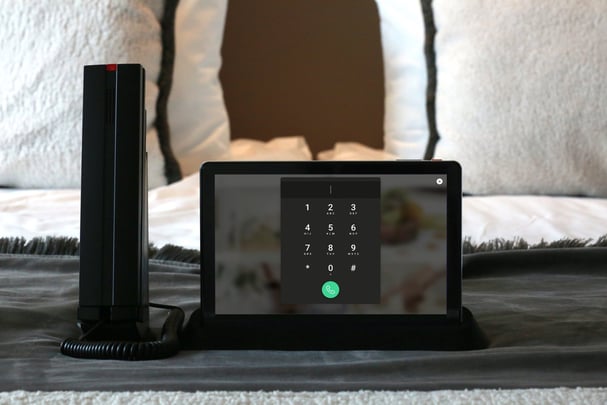
This is the newest option. One device on the nightstand handles everyday requests on a screen, and a real handset takes care of calls.
Good for: hotels that want fewer calls at the front desk without removing the phone.
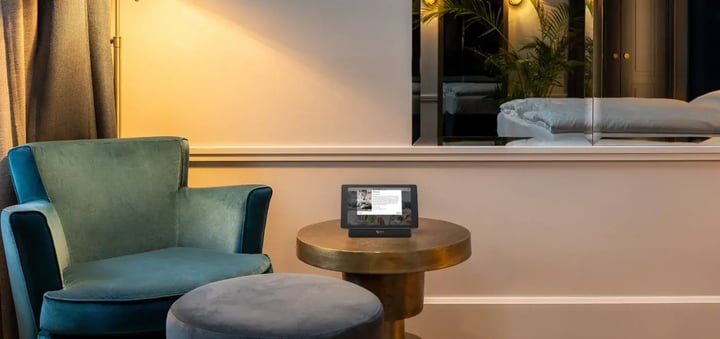
This is the idea behind the SuitePad Phone Dock. It puts the SuitePad in-room device and a hospitality handset in one unit. It comes in an analog and an IP version and works with the phone system you already have, so there is no new PBX to buy. It supports VoIP and SIP and is built for Kari's Law and RAY BAUM's Act. If you want the story behind it, watch our interview with the team who built it.
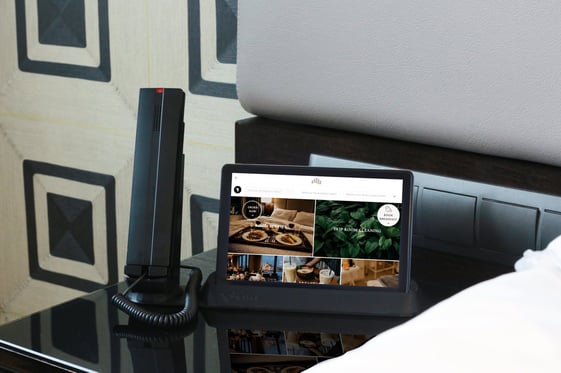
Guests order room service, book the spa or skip housekeeping on the screen. When they want to talk to someone, they pick up the handset. Hotels using SuitePad have cut call volume by up to 90%.
Watch out for: it is new hardware in every room. It makes the most sense when your current phones are due for replacement anyway.
All five at a glance
| Option | Best for | Main watch-out |
|---|---|---|
| Analog + on-site PBX | Working systems, tight budgets | Copper networks are being switched off |
| IP + on-site IP PBX | New builds and renovations | Higher cost per room, needs network ports |
| Cloud PBX | Less hardware, monthly billing | Depends on internet, fees add up |
| Mobile and apps | Quick requests, small hotels | No room location, low app downloads |
| In-room device + handset | Fewer calls, same phone line | New hardware in every room |
How to choose
Start with three simple questions.
- How old is your system? Ask your telecom provider when they plan to retire copper in your area.
- How good is your in-room network? IP and cloud options need a strong one.
- What do guests actually call about? Pull your call logs. If most calls are about towels, Wi-Fi and room service, those requests don't need a phone call.
The bottom line
The room phone is not going anywhere just yet. It keeps guests safe, and it gives them a familiar way to reach you.
But everything around it is changing. Copper is going, guests prefer to text, and your team has less time to answer the phone. The best setup keeps the handset for the calls that matter and moves everything else to a screen.
SuitePad is the guest communication platform for hotels: in-room tablets that replace the hotel phone, enable self-service, and pay for themselves through revenue share. Used by 800+ hotels worldwide.
See how in-room feedback stops bad reviews before they happen.
A 20-minute demo tailored to your room count and guest profile. No commitment.