Customer Login
.svg "SuitePad")
 How SuitePad's smart room service recommendation feature helps upscale and luxury hotels increase order value by surfacing the right add-ons at checkout.
Room service has an upsell problem. Not a revenue problem. Hotels with strong in-room dining programmes generate serious ancillary revenue. The problem is the moment.
When a guest picks up the phone to order, there is invisible pressure on both sides. The staff member wants to close the call. The guest does not want to seem indecisive. Nobody suggests the chocolate fondant. The decision window opens and closes in under two minutes.
This is not a training issue. It is structural.
What E-Commerce Figured Out Years Ago
Retail and food delivery cracked this a long time ago. Uber Eats, Deliveroo, and Amazon don't upsell you during a phone call. They do it at the exact moment you're already in a buying mindset, already committed, already reaching for your wallet.
The checkout recommendation works because of three things:
-
Timing: the suggestion comes after the hard decision is made, not before
-
Relevance: it's specific to what you already chose, not a generic menu
-
Zero friction: one tap adds it; declining costs nothing
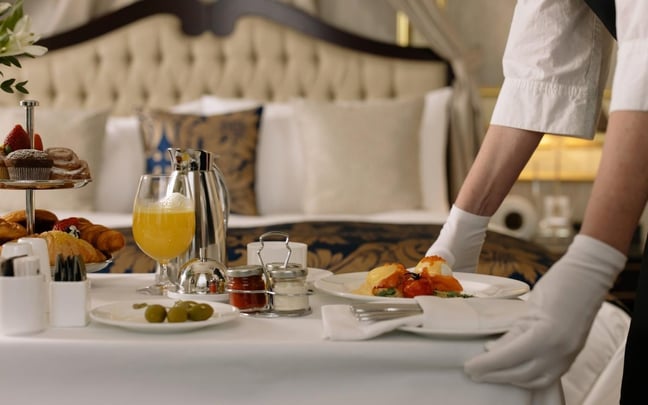
Hotels have largely missed this. Not because the logic doesn't apply, but because the delivery mechanism wasn't there. A phone call can't show you a picture of the chocolate fondant. A waiter at the door has already arrived.
What Changes When Guests Order on a Device
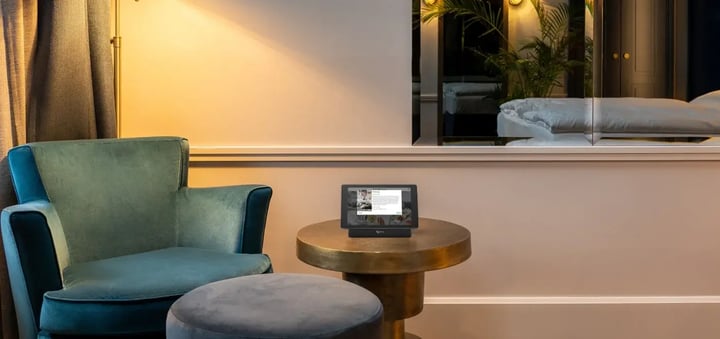
Hotels that switch from phone to digital ordering see 15-25% higher room service check sizes. Guests browse at their own pace, see photos, and consider options they would not have thought to ask about. Nobody is waiting on the other end of the line.
That lift, 15 to 25%, is just from switching the channel. At active SuitePad properties, 60-80% of all room service and in-room dining revenue already comes through the device before any upsell logic is applied. Hotels like Elounda have seen EUR 200,000 in in-room ancillary revenue in a single season.
The question is what happens when you add a recommendation at exactly the right moment.
What a Well-Placed Recommendation Actually Looks Like
The ones that work share a few characteristics. They are specific, not generic. "Would you like to add anything?" is a phone call. "Guests who ordered this also added the lemon tart" is a recommendation. And they arrive at the point of confirmation, when the guest mindset has already shifted from considering to buying.
In upscale and luxury hotels, they feel like a service, not a sales tactic. A well-placed suggestion, a drink that pairs well, a dessert that rounds out the meal, lands as helpfulness. Guests in this segment notice when hospitality technology feels pushy. When it does not, they spend more.
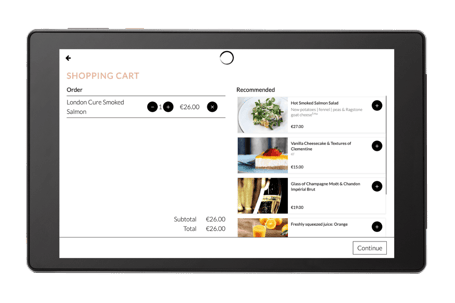 SuitePad AI's smart recommendation feature does exactly this. At the moment a guest is about to confirm their room service order, it surfaces a small set of relevant add-ons configured by the hotel.
What's more, every item added through a recommendation is tracked separately in the admin panel, so hotels can see precisely what the feature contributes to F&B revenue and which categories convert best.
The Operational Logic Is Hard to Argue With
A waiter is making the trip either way. Whether the tray carries one dish or three, the cost of that delivery is roughly the same. The incremental ancillary revenue from a well-placed recommendation has almost no incremental cost attached to it. The unit economics are unusually favorable compared to almost any other TRevPAR lever a hotel can pull.
Getting It Right
A few practical starting points for hotels thinking about in-room dining upsell:
- Configure by category, not just by item. What pairs with a burger? What makes sense at 10pm versus 7pm? Contextual logic outperforms a static list.
- Track recommendation-driven F&B revenue separately. If you cannot see what the feature contributes, you cannot optimise it.
- Start with three to five items. Too many choices recreate the paralysis of the phone call.
The best room service upsell is not a harder sell. It is a better moment.
SuitePad is the guest communication platform for hotels: in-room tablets that replace the hotel phone, enable self-service, and pay for themselves through revenue share. Used by 800+ hotels worldwide.
See how in-room feedback stops bad reviews before they happen.
A 20-minute demo tailored to your room count and guest profile. No commitment.