Customer Login
.svg "SuitePad")
Chasing a Forbes Travel Guide rating, or defending one, comes down to hundreds of small moments. Many of them happen inside the guest room, where the hotel has the least direct staff presence and the most room for a point to slip away.
The good news: a large share of the in-room and digital standards are within your control. They are not about spending more on marble or thread count. They are about response times, request handling, and the quality of the information a guest touches. And the data shows the gap between properties that get this right and those that do not is wide, measurable, and driven by execution rather than budget.
Here are the six gaps we see most often, the numbers behind them, and how to close each one.
1. Response times are measured, and they are short
Evaluators care about how fast a request is acknowledged and acted on, and guest expectations have moved faster than most hotels have. Across service industries, 65% of consumers buy from the first business that responds, and in hospitality that window is short. Recent studies show more than 65% of travelers now expect a hotel to respond within an hour across any channel, conditioned by the airlines, apps, and messaging services they use every day (source).
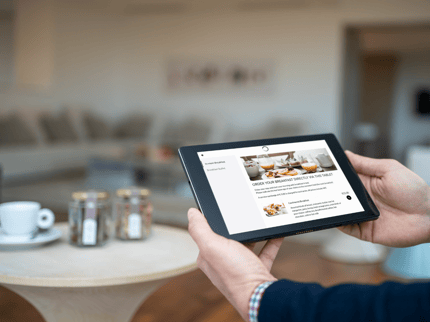 Our own order data makes the cost concrete. In room service, hotels that confirm a request in under five minutes lose only 2.2% of orders to rejection. Hotels that take longer than 15 minutes lose 5.95%, almost three times as many. For a property running 100 orders a month, that gap is worth roughly 2,200 euro a year on a single service line.
The fix is a request channel that routes instantly to the right department. The fastest properties in our dataset are not working harder; they use consistent digital routing. One resort reaches a median response time of 24 seconds. When a guest can send a request from an in-room device and it lands directly with housekeeping or the front desk, the acknowledgement happens in the window evaluators expect, not whenever someone gets to the voicemail.
2. Guests should never have to repeat themselves
One of the most consistent themes across the standards is cross-departmental communication. A request made once should reach the right person without the guest explaining it twice. Guests do not just want speed; they want context, and they do not want to re-explain a request to three different people. Yet most hotels still treat each channel as a separate silo, with different staff, or no one, monitoring each.
The scale of the shift is easy to underestimate. Around 44% of guests now prefer to make service requests digitally rather than at the front desk, and industry forecasts put roughly 80% of customer interactions running through digital channels (source). A central digital request system captures the request once and conveys it to the department that owns it. The guest asks a single time. The handoff happens behind the scenes.
3. In-room dining lives and dies on timing and accuracy
In-room dining carries some of the most demanding expectations of the whole guide. Delivery windows are quoted and expected to be met. Dietary needs should be captured before the order, not discovered at the door. Orders should arrive accurate, with no guessing about who ordered what. It is also the single clearest example of how execution, not location or star rating, separates strong properties from weak ones.
Digital ordering handles the parts humans forget under pressure. Preferences and allergies are captured at the source. The delivery estimate is set clearly. Order accuracy improves because nothing is transcribed from a rushed phone call. The revenue upside is real too: orders placed on in-room devices run 10 to 30% higher in value than phone orders, and adding simple order options such as sides and upgrades lifted average order value by 29% across the properties that switched them on.
4. Printed collateral is an easy point to lose
 In-room collateral is expected to be current, accurate, grammatically correct, and in excellent condition. Printed directories struggle on all four over time. They go out of date, they get dog-eared, and one stray typo is a deduction sitting in plain view. There is a discovery cost too: 39% of guests say they would use a digital screen just to find the Wi-Fi password, which tells you how many never reach for the printed folder at all (source).
A digital directory is always current and always pristine. Update it once and every room reflects the change. There is no stack of laminated cards slowly aging in a drawer, and no typo quietly repeating across 200 rooms.
5. In-room technology has to feel effortless
Where technology is provided, it is expected to be intuitive and to work seamlessly. Clunky, confusing, or broken tech is worse than no tech at all, because now it is a thing the guest struggled with during the exact stay being evaluated. Guests are unforgiving here: 87% say they will not return after an unsatisfactory experience, and the standard they judge against is set by the smoothest apps they already use (source).
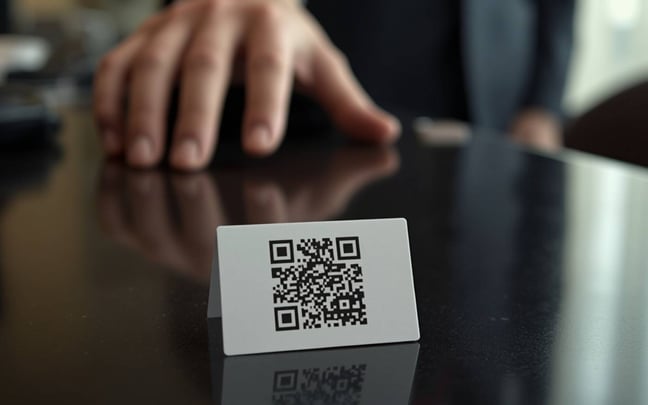
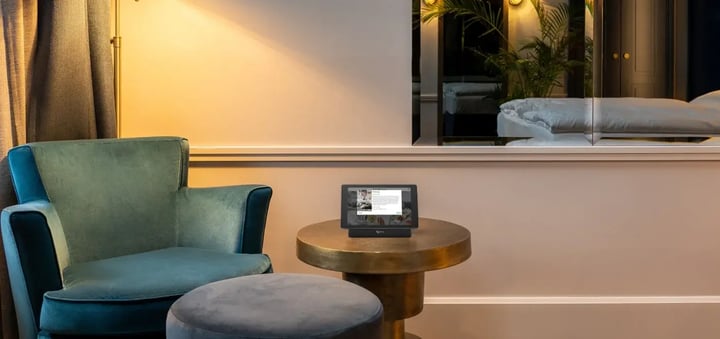
The bar is simple to state and hard to clear: a guest should be able to pick it up and use it without instruction. The format matters too. Fixed in-room tablets generate 20 to 30 times the guest interaction of QR-code alternatives, because the barrier to picking them up is near zero. That is a product design question, not a feature-count question, and it is worth testing from the guest's side of the screen before an evaluator does.
6. Digital should extend the human touch, not replace it
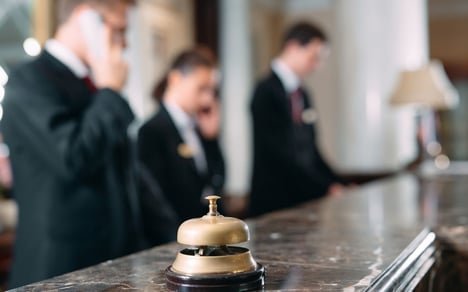 Worth saying plainly, because buyers ask: the standards expect non-digital alternatives to remain available alongside any automation. Five-star digital does not mean removing people. It means giving the guest a faster path when they want one, and freeing staff to deliver the personal moments that no tablet can. Automation earns its place by resolving the basics or routing them fast, not by stalling politely.
The properties that score well treat in-room technology as an amplifier of service, not a substitute for it. The pattern in the data is consistent: the winners run the fundamentals well and let technology carry the repetitive load so people can focus on the moments guests actually remember.
Where to start
If you are working toward a rating, or protecting one, the in-room standards are among the most improvable areas you have. They reward speed, consistency, and polish, all of which are easier to guarantee with the right system in place than with manual effort alone. And as our benchmark data shows, the properties that pull ahead do not have better locations or bigger budgets; they execute the fundamentals more consistently.
Sources: SuitePad Room Service Benchmark Report 2026 (900+ hotels, 32 countries); Shiji Guest Experience Benchmark; Hotel Tech Report State of Guest Tech; industry guest-messaging research, 2025 to 2026.
SuitePad is the guest communication platform for hotels: in-room tablets that replace the hotel phone, enable self-service, and pay for themselves through revenue share. Used by 800+ hotels worldwide.
See how in-room feedback stops bad reviews before they happen.
A 20-minute demo tailored to your room count and guest profile. No commitment.