Customer Login

The hotel phone has barely changed in 30 years. It sits on almost every nightstand, it's required by regulation and brand standards, and most guests hardly touch it.
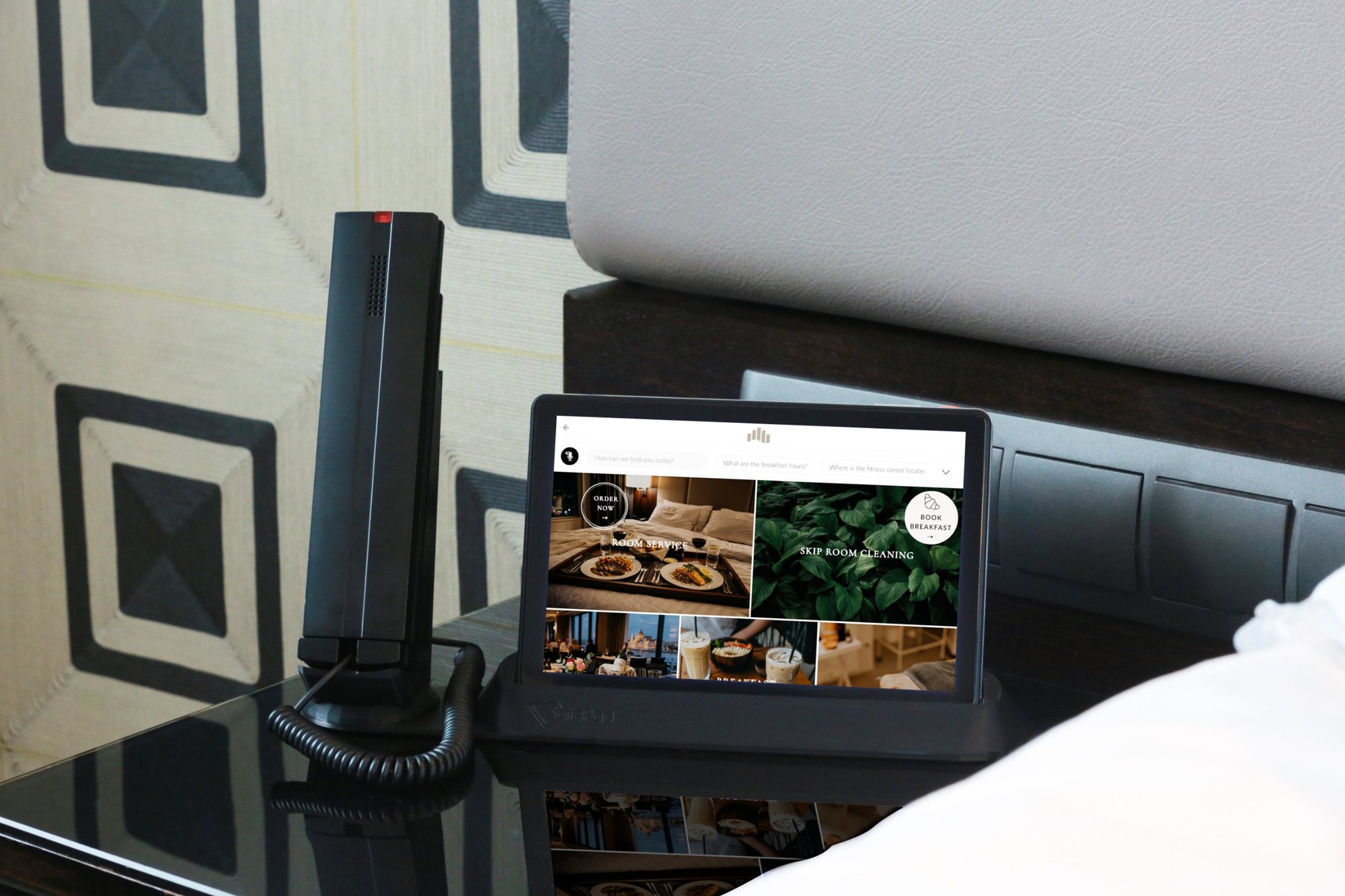
We wanted to change that without taking the phone away. The result is the SuitePad Phone Dock: the SuitePad in-room device, its charging dock and a real phone handset, combined in one unit. After months of design, prototyping and customer feedback, it's now available to hotels everywhere.
To mark the launch, I sat down with Tilmann Volk, SuitePad co-founder and Managing Director, and Paul, our head of engineering, to talk about how the Phone Dock came to be, what was harder than expected, and why hotels should care. Here is our conversation, edited for length and clarity.
What is the problem with the hotel phone today?
Tilmann: Hotel phones have not really been innovated in the past 20 or 30 years. In a way that is a good thing, because guests know what it is. But the key issue is that it is hardly used. It has to be in the room for regulatory reasons, and sometimes for brand standards, but usage is low. With everything guests already do on the SuitePad, bringing the phone onto the same device felt like a natural next step.
Paul: Today a room often has a phone, a remote control, a tablet and maybe printed information. Every one of those needs to be cleaned and maintained, which adds work for the hotel. You can't take the phone out of the room, so we put it together with the SuitePad in a single unit.
What was your goal when designing the Phone Dock?
Tilmann: Three things mattered most. First, the phone had to be part of the unit: tablet, charging dock and handset, all in one. Hotel rooms are short on space and often cluttered, so a nightstand with one device instead of three makes a real difference.
Second, discoverability. Guests should see immediately that this is a phone. Hiding calling behind a tablet would be counterintuitive.
Third, retrofittability. We wanted to walk into a hotel with old analog infrastructure, or nothing in place at all, and upgrade it from where it is.
What did that mean for the engineering team?
Paul: It meant building one system that works with many different technologies. Some hotels have plain old analog phone lines in the room. Others have network cables and run voice over IP. The Phone Dock had to fit both.
It also had to be a real phone. It has its own keypad and works on its own, even if the tablet is off the dock or out of battery.
How does a hotel know which version to choose?
Paul: It is quite simple. If your room has the classic phone socket in the wall, you most likely have an analog system and want the analog version. If you have a network outlet, you can usually choose the IP version. If you have both, your IT team will know what your phone system supports, and our experts are always happy to help you decide.
What took longer than expected?
Tilmann: Making the design this simple. We had lots of ideas about where the handset should go: behind the tablet, on the left, on the right. How big the gap should be, how close to the tablet, which angle. I changed my mind a bunch of times. But I am very happy with the result. The angles match, the gaps match, and the position tells guests right away: this is a phone you can use.
Paul: Early on, partners in the US and Europe told us analog systems were still the most common in hotel rooms, so we designed for that. Once we showed the first prototypes to customers, we learned that wasn't quite true. So we adapted the design to fit an IP phone as well. That was one of the biggest changes, and it came directly from talking to customers.
What surprised you most?
Tilmann: Choosing 3D printing over injection molding. It has proven to be the right call, because it lets us adapt the product to what customers need. We print every unit ourselves, on a printing farm we built and run in-house, especially the tablet holder, the phone holder and how the two fit together.
How does it work in practice?
Paul: The phone works independently of the tablet. It is powered through its own outlet or through power over Ethernet. Beyond that, it is a standard hotel phone: a message waiting light that is visible from both sides, speed dial buttons and a keypad, just as guests expect.
A phone is a phone. Why should hotels care?
Paul: It brings two devices together that would otherwise be separate, which saves space on small nightstands. And on the SuitePad, guests can already find hotel information, book services and message reception. But picking up the phone and talking to someone should always be an option. That is why the two belong together.
Tilmann: We believe calls to reception should be kept to the minimum that really needs a person. Guests are used to smartphones and tablets, so they naturally check the screen first. When the phone sits right next to the screen, most questions get answered there, and the calls that do come through are the ones that matter.
"Our phones work fine. Why should we change?"
Paul: Because now there is one place for the guest to interact with your hotel, instead of devices spread across the room. You still need a phone for emergencies and brand standards. So why not make it part of a single guest engagement hub?
Tilmann: And installing it is simple. We need power and guest Wi-Fi for the tablet, and the phone connects to whatever phone infrastructure you already have, analog or Ethernet. You plug it into the wall and you are good to go.
When can hotels get it?
Paul: It's available now. We are producing units and the first ones are already shipping.
Tilmann: So: now.
Where will the in-room phone be in five or ten years?
Tilmann: Guests will still need to reach the reception by voice, and possibly partners outside the hotel too. So phones will stay, not only for regulation but for customer service. What will change is how calls are handled. Today every call goes straight to reception. I believe that in the future there will be a voice layer in almost every hotel that answers the simple requests automatically and passes through the ones that need a person. When the device and that voice layer come together, that is the most powerful way to serve guests.
 Bring the Phone Dock to your rooms
The SuitePad Phone Dock comes in an analog and an IP version, and both work with your existing phone system. Talk to your SuitePad account manager or book a demo to find out which version fits your hotel.
SuitePad is the guest communication platform for hotels: in-room tablets that replace the hotel phone, enable self-service, and pay for themselves through revenue share. Used by 800+ hotels worldwide.
See how in-room feedback stops bad reviews before they happen.
A 20-minute demo tailored to your room count and guest profile. No commitment.